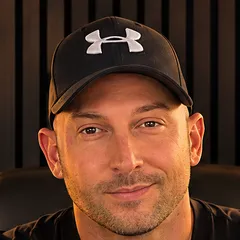
You tried an AI avatar app once. You got a stiff face reading your words in a voice that wasn't yours.
That's what happens when you ask one tool to do everything. My twin uses 3 tools, and each one only does the thing it's best at.
And none of them write a single word. I write the script with Claude, and I read every line.
1The 3 tools and the job each one does
ElevenLabs makes the voice. I use a professional clone of my own voice. You give it real recordings of you talking, and it learns how you sound. ElevenLabs only lets you clone your own voice, and it makes you verify it's you. Their docs ask for at least 30 minutes of clean audio for a professional clone, and more is better. It's on their paid plans.
HeyGen makes the video talk. You give it a photo of you and the voice. It moves your face and lips so they match the words.
Higgsfield makes the scenes. It takes your real photo and puts you in new places, like your office. It also makes the B-roll: the short clips of you doing things that play over the voice.
Voice, talking video, scenes. Three jobs, three tools.
25 things that keep a twin from looking fake
These are the things that give a twin away. Here's what I learned building mine.
1. Start from a real photo, mouth closed. A real photo of you looks more like you than an AI-made one. A closed mouth keeps the teeth from looking strange when it starts talking.
2. One scene per video. Jumping from place to place is where it starts to look fake. Pick one spot and stay there. Change the camera angle if you want variety, not the room.
3. Never let the twin talk while it walks. AI walking still looks off. If your story happens on a walk, show the walk as B-roll over the voice, and keep the talking parts sitting down.
4. Wear a plain shirt. Image tools love to invent logos and words that aren't real. Check every shirt and every wall in every scene for made-up writing.
5. Label it as AI. Use the AI label on the platform when you post, and say it in your bio. Be upfront about it. Nobody likes finding out later.
3The prompt that writes your twin's script
The twin is only as good as the words you give it. Mine never comes up with a word on its own. I write the script with Claude, and I read every line before the twin says it.
This prompt does the writing part. It asks you questions first, so the script sounds like you and only uses things that really happened.
Open the Claude desktop app, click the Code tab, and pick any folder. Fill in the 2 lines at the top, then paste the whole thing.
Topic: [what this video is about, in one line]
Who it's for: [who you help, in one line]

You're writing a 45 second script for my AI twin. The twin is a video of me with my own cloned voice. It says the script word for word, so the script has to sound exactly like I talk.

Before you write anything, ask me these questions one at a time. Wait for my answer before you ask the next one.
1. What do you want people to think, feel or do when it ends?
2. What's one real moment from your business or your life that shows this? What happened, when, and what did you do?
3. Paste 2 or 3 things you wrote or said in your own words, like a post, a caption or a DM, so I can hear how you talk.
4. Are there any words or phrases you'd never say?
5. How should it end? A question, "follow for more", or a word to comment.
If an answer is too thin to write from, ask one short follow-up. Then write.

How to write it:
- 110 to 150 words. That's about 45 seconds out loud. Count the words and put the count under the script.
- The first line is the hook: one plain sentence that makes [who it's for] stop scrolling.
- Write it to be heard, not read. Short sentences. Words I'd say out loud. Contractions. Use my words from question 3, not yours.
- Only use facts I gave you. If the script needs a story, number, name or result I didn't give you, leave a blank like [my story: ...] or [number: ...]. Never make one up.
- No promises to the viewer, like "this will get you clients" or "guaranteed".
- No hashtags, no emojis, no stage directions, and no long dashes. Just the words the twin says.

After the script, list every fact you used and which of my answers it came from.
When the script is done, read it out loud before the twin does. If there's a line you'd never say, change it. That's the part you never hand over.
The limitations you should know
- This is the 3 tools and what each one does, not the full build. The buttons and settings change often. Each tool's own help docs are the place for those.
- All 3 tools cost money for real quality, and the costs add up when you post every day.
- A twin still slips. Lips that don't match, odd teeth, strange hands, made-up words in the background. Watch every clip before it goes out.
- Only your own face and your own voice. Never make a twin of someone else.
- The script is only as good as what you tell Claude. If you give it nothing real, you'll get a blank where the story should be. That's on purpose.
Want the next guide? Follow @zachcrawford.ai